

















By Carolyn Newcomer Ketchel

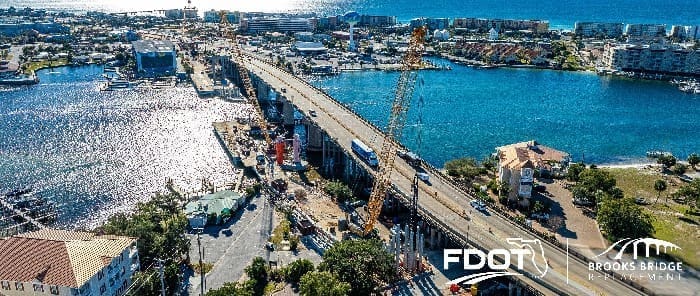
I have watched with fascination the construction progress of the new Brooks Bridge. I am not an engineer. So, to me, it is a wonder to see the first half of the new bridge coming together from opposites sides of The Sound. The John T. Brooks Bridge has served as the vital link between mainland Fort Walton Beach and Okaloosa Island since 1966. The original Brooks Bridge was opened in 1935, and was a low-level swing bridge. The swinging center span required a bridge tender to turn the span sideways to allow for tall boats to pass through. Before the swing bridge was built, ferries were used to transport citizens from Fort Walton Beach to Okaloosa Island.
Could you guess that the average annual daily traffic count is 66,000 vehicles? The old four-lane structure is no longer sufficient to support the traffic count. The ongoing $171.8 million design-build project is replacing this aging landmark with twin parallel spans that will fundamentally change how we move through our south county. Thankfully, for the most part, the traffic delays have not been too lengthy.
It’s easy to look at the massive cranes, intricate steel reinforcements, and the logistical nightmare of rerouting modern traffic and feel like we are facing an unprecedented challenge with the Brooks Bridge replacement. The project is undeniably complex, requiring precise coordination between environmental protections, maritime navigation, and the structural demands of spanning the Santa Rosa Sound. Yet, when we zoom out, we see that the Brooks Bridge is part of a grand, millennia-old tradition of human defiance against geography. We are a species that looks at a gap and insists on a path.
Let’s take a closer look at the Key Improvements:
- Expanded Capacity: Moving from 4 lanes to 6 travel lanes (three in each direction).
- Enhanced Safety: 10-foor inside and outside shoulders to prevent traffic gridlock during minor accidents or breakdowns.
- Pedestrian Access: Each side will feature a 12-foot wide shared multimodal path featuring scenic overlooks and shade structure, fully separated from vehicle traffic by protective barrier walls. This will link to our bike bath on the south side that can be walked or biked all the way to Destin (Marler Bridge).
- Navigational Clearance: Vertical clearance is being increased from 50 feet to 65 feet to meet modern U.S. Coast Guard regulations for the Gulf Intracoastal Waterway.
- Eliminating Santa Rosa Blvd Signal: One of the most significant improvements will be the removal of the traffic signal at Santa Rosa Boulevard. The new bridge extends over this intersection, allowing US 98 traffic to flow uninterrupted while the new “connection” roads handle local island traffic underneath the bridge.
- East Connection: A new 4-lane road linking Santa Rosa Blvd to US 98 Eastbound.
- North Connection: A dedicated ramp providing seamless access for Westbound drivers.
Engineers have been solving “impossible” infrastructure puzzles since the dawn of civilization. Long before we had computer-aided design or hydraulic machinery, our ancestors were calculating load distributions and hydraulic pressures with startling accuracy. The same spirit of rigorous planning and problem-solving currently being applied to the piles and piers in Fort Walton Beach has echoed through history—from the Roman aqueducts to the Great Wall. Modern technology has changed our tools, but the fundamental logic of engineering remains a constant thread in the fabric of human progress.
One of the most mind-bending examples of this ancient expertise is Hezekiah’s Tunnel, constructed in Jerusalem around 700 BCE, and mentioned in the Bible in the book of 2 Chronicles chapter 32. Faced with an impending siege by the Assyrians, King Hezekiah needed to secure the city’s water supply by diverting water from the Gihon Spring to the Pool of Siloam. The catch? The spring sat outside the city walls, and the path to safety lay through roughly 1,750 feet of solid limestone bedrock.
What makes this project a marvel of engineering is how it was built. Two teams of laborers started at opposite ends, tunneling toward each other through the dark rock in a “S” curved path. Without GPS or modern surveying equipment, they managed to meet in the middle with an error of only a few feet. An ancient inscription found on the tunnel wall describes the moment the two teams heard each other’s picks through the stone and finally broke through to join the two halves.
Even more impressive is the gradient. To ensure the water flowed properly, the tunnel had to slope downward at a very specific, incredibly slight angle. Over its entire 1,750-foot length, the floor drops only about 12 inches. This level of precision—achieved with hand tools and oil lamps—proves that while the Brooks Bridge is a major undertaking for 2026, the “complex project” is a challenge we’ve been winning for nearly 3,000 years.
Make sure to watch the video at https://www.youtube.com/watch?v=aK9AiY4DXI4 to learn more about this exciting project.
It is an honor to serve as you County Commissioner!
Carolyn Ketchel is Okaloosa County Commissioner, District 2. She can be reached at CKetchel@myokaloosa.com or 850-651-7105