



















By Kassia Garfield, physical therapist & owner, MaxStrength Fitness FWB
Starting in your 40’s, everyone experiences a natural process called sarcopenia, which is the degenerative loss of skeletal muscle mass, at the rate of about 3 to 5% every decade. That is why strength training has a profound effect on a person’s physical and mental abilities. When we lose our muscle mass, it affects all of our other sub systems. It can affect balance, joint health, posture, weight management, endurance, mental health, functional independence and overall longevity. Strength training has a pivotal role in maintaining muscle mass and improving overall health. Without actively counteracting sarcopenia, the loss of muscle mass will continue to accelerate, leading to decreased strength, reduced mobility and a greater risk of injury and loss of independence.
Why Strength Training is Significant?
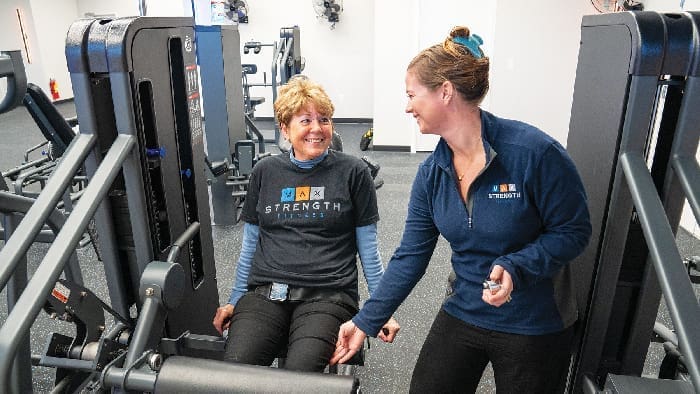 Strength training has the benefits of many other forms of training. For example, it can bring some significant improvements to a person’s cardiovascular health, because by making muscles work harder, the heart and lungs must work harder. Strength training also increases flexibility as the exercises put muscles through a full range of motion, stretching them, and increasing pliability at end ranges. Strength training improves a person’s overall health profile, making positive changes to cholesterol, blood pressure, blood, sugar, and bone density while also sustaining fat loss.
Osteoporosis can be battled by just increasing strength training. Osteoporosis is the loss of bone density. Muscles attach to bones, so if muscles are consistently being stressed, they are pulling on bones, which starts the natural process of laying down more bone, to counteract the stress of muscles pulling on the bones, and this then increases bone density.
The Cleveland Clinic has shown that there is a significant reversing of osteoporosis just by adding in strength training. Many older adults enjoying walking as a form of exercise. But, this is not the same as strength training. Anything that can physically fatigue the muscle will drive muscle mass changes. But, we have to ‘overload’ the muscles. This means that we have to stress the muscle to create physiological changes. Always doing 5 lb. bicep curls and never increasing the weight will not create change. That can include bodyweight exercises, machines, free weights, etc. There are a lot of ways to go about it. The simplest introduction is through bodyweight exercises, like push-ups, pull-ups, squats, and planks–anything that can be done without equipment including strength exercises. Those exercises can be dynamic, which is movement such as a push-up movement, or a more static movement which should be more of a plank. This depends on the body’s abilities. Even people with physical limitations can start strength training while using bodyweight exercises.
How Can Improving Strength, Improve Mental Health and Combat Stress?
Improving physical strength has a substantial positive impact on a person who is often under significant mental stress, such as a CEO, by enhancing mood and reducing stress. Regular strength training releases endorphins, the body’s natural feel good hormone, which can lead to an overall improvement in mood, decrease feelings of anxiety, and can boost confidence and self-esteem. As physical strength improves, so does a person’s quality of sleep, which has significant benefits of mental health. Additionally, the mental time-out of doing exercise and physically taxing the body reduces physical symptoms of stress, such as muscle tension and headaches. Also, for aging adults who are beginning to notice changes in their abilities—and feel frustrated by tasks that once came easily but are now more challenging—strength training can help restore a sense of independence. By improving daily physical function, it can enhance overall confidence and lead to greater satisfaction in retirement.
When “I Don’t Have Time” Is the Obstacle: How to Make Time and Get Started Safely
Many people feel intimidated by the traditional gym setting, especially if they’re unfamiliar with the equipment or exercises. That’s where working with a professional can help. A trainer provides accountability and proven systems that take the guesswork out of exercise.
Left on their own, many people abandon a program when it becomes challenging. But that’s often when they need to keep going—pushing past fatigue to see results. A trainer ensures exercises are performed correctly and safely, while guiding clients to progress beyond where they’ve been.
Working with a trainer also saves time. With experience and knowledge of the science, a trainer can design an efficient, personalized program and walk clients through it step by step. There’s no need to worry about logistics—just show up and do the work.
Often, the hardest part is simply walking through the gym door. Once there, a trainer provides structure, support and an effective workout in a fraction of the time most people would spend on their own.
Kassia is a physical therapist, veteran, educator and life transformer at MaxStrength Fitness of Fort Walton, a fitness studio designed for busy professionals and active aging adults. While that is their primary focus, anyone committed to improving their health and a better life is welcome.
At MSF, workouts use a slow, controlled, continuous-motion approach that is safe and gentle on joints while maximizing effort—delivering an efficient, effective workout in just 20 minutes, twice a week.
For a no-cost, low-risk consultation, call 850-467-9729.