








































By Sherry Jones Olney
In a previous article, we explored how Cold Night opens when temperatures turned dangerous. What often goes unseen are the people who live through those nights — and the ones who show up to make sure they don’t face them alone.
Winter did not ease its way through the Emerald Coast this year — it lingered. A relentless series of cold snaps settled in, bringing temperatures our region is simply not accustomed to and pushing One Hopeful Place into response mode.
Cold Night — a program designed to open during dangerously cold weather — stretched far beyond its usual scope this winter. What typically operates intermittently became consecutive shelter operations as conditions worsened. As this article is being written, Cold Night is still ongoing. By the time it reaches print, One Hopeful Place will have likely remained open close to 30 consecutive nights — something highly unusual for Northwest Florida.
The wind comes first.
It cuts through jackets and layers that never feel thick enough. When temperatures drop into the low 20s, the cold settles fast — numbing fingers, stiffening joints, making every step heavier. The wind makes it worse, stripping away any warmth the body tries to hold.
For those without shelter, there is no escaping it. There is no door to close. No heater to turn on. No dry place to wait it out. Each night becomes a calculation: how to stay alive until morning.
This is their story.
Don’t Look Away
Ron is from Fort Walton Beach. For years, he worked as a plumber and fixer — the kind of man people called when something broke. He raised his sons here. This was home.
A decade ago, everything began to unravel. The market collapsed. Jobs disappeared. Steady work became inconsistent, then nonexistent. Stability slipped away — not because Ron stopped trying, but because sometimes effort alone isn’t enough to stop a fall.
For more than two years now, Ron has lived without a home. He moves quietly, carrying everything he owns with him.
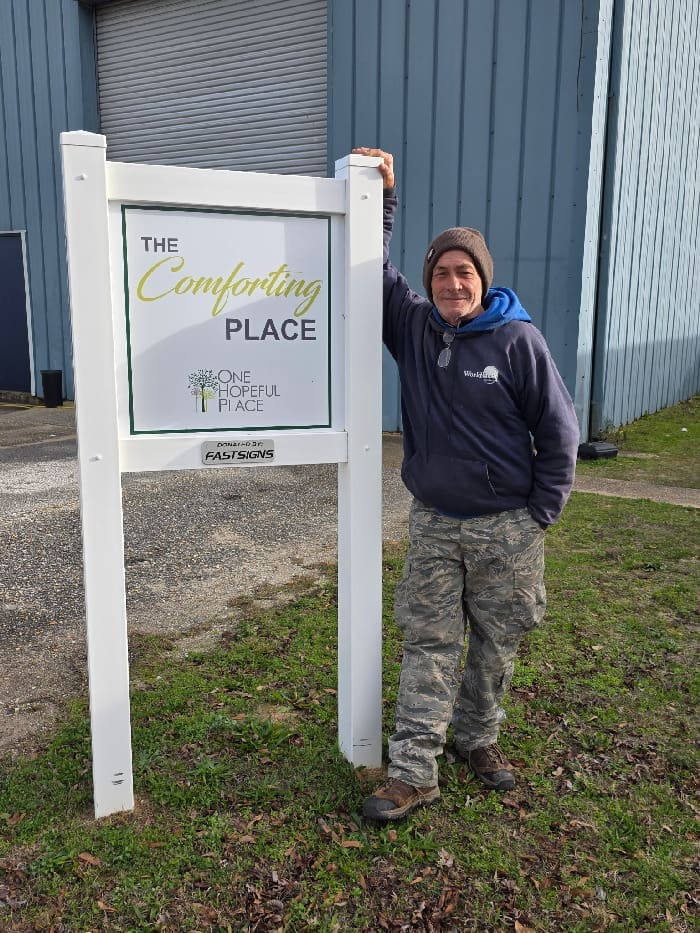
During the day, Ron rides his bicycle across town looking for work, food, and a safe place to rest.
On the coldest nights, Ron finds a bed inside The Comforting Place at One Hopeful Place, where Cold Night opens its doors when exposure becomes life-threatening.
Without Cold Night, Ron said he would have no choice but to sleep outside — fully exposed to conditions he has endured before. “Knowing there’s a place like this changes everything,” Ron said. “Not every city has somewhere you can go when it gets this cold. To have heat, food, and to be treated like you matter — I don’t know what I’d do without it.”
When asked what the community could do for people experiencing homelessness, his answer came without hesitation. “Don’t look away,” he said. “We want help. We want to work.”
Cold Night didn’t fix everything. But it kept him alive long enough to keep trying.
You Stop Feeling Worthy
For the past three years, Charles has lived on the streets — sleeping wherever he can find brief safety, carrying everything he owns because leaving it behind means losing it.
He was once enrolled in college, pursuing advanced studies in physics, when depression and mounting responsibilities overtook his ability to continue. One loss followed another, and stability slowly slipped away.
Now, he sleeps in abandoned spaces, under bridges, or anywhere that isn’t illegal or immediately unsafe — places chosen not for comfort, but for survival. He avoids locations where people stare.
He carries everything he owns with him, knowing that if he leaves it behind — even briefly — it may be gone when he returns. “Being judged for carrying your life with you is soul-crushing,” he said.
On Cold Nights, survival becomes even harder — staying dry, staying warm, and staying safe as the wind makes the cold even harder to endure. That’s how Charles found One Hopeful Place — through quiet word of mouth shared among those living outside.
Without access to basic needs, dignity is often the first thing lost. And when dignity erodes, self-worth follows. “You stop feeling worthy of help,” Charles said.
Cold Night didn’t just offer warmth. It offered dignity.
The Hearts That Serve
Cold Night does not happen without volunteers.
Behind every night the doors stay open are people. This winter, those people stepped forward — the individuals who depend on Cold Night, and the volunteers and community partners who make it possible. The nights are long, but no one is left to face them alone.
Some arrive before sunset to help prepare the space. Others come late, after long workdays, to stay through the night. Many return again and again — not for recognition, but they know what’s at stake.
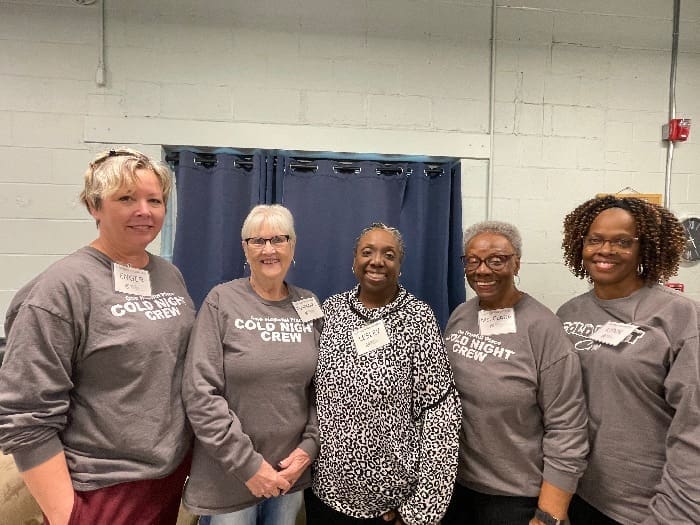
Lesley Sasser has volunteered for nine years, following the example set by her mother. “Sometimes it’s just remembering someone’s name and making them feel special,” she said. “And that matters.”
Rosemary Hilliard treasures the quiet moments — hugs, thank-yous, and simple gratitude offered by hands still cold from the night air. “What we do might not feel like much,” she said, “but it makes my heart happy.”
Enger Clements, a volunteer of six years, summed it up simply: “This is a place where people are treated like people.” They show up because they understand what the cold can do — and because making sure everyone is safe matters.
Alongside them are volunteers who return faithfully, night after night: Clara Oates; Darryl and Lynn Wilson; Jordan Sasser; Chris and Paula Previte; and Pastor Joe and Dawn Wilson — showing up because the work still needs to be done.
All Cold Night volunteers serve at One Hopeful Place, helping prepare spaces, welcome guests, and ensure safety throughout the night.
Faith in Action
When Cold Night stretches on for weeks, meals are not supplemental — they are essential.
Hot dinners and early-morning breakfasts become anchors of warmth, provided by faithful community partners who return week after week, including Seventh-day Adventist Church, First Christian Church, First Presbyterian Church, First Baptist Church of Fort Walton Beach, Trinity United Methodist Church, Taking It to the Street Ministry, and the Janet Boldin Foundation, along with individual meal sponsors Darryl Wilson and Kristen Shinnick.
More Than a Bed for the Night
Cold Night is often the first point of contact — but it is not the end of the story.
While participants are inside, Cold Night also creates an opportunity to connect them with resources and support that can help move them toward stability.
Beyond Cold Night, One Hopeful Place is already home to 67 residents working toward stability through transitional housing. The campus also ensures that a bed is always available for homeless veterans.
During extreme cold, the 48-bed emergency shelter reaches capacity quickly — serving not only individuals experiencing homelessness, but also local residents who arrive without heat, power, or access to food when conditions become dangerous.
Cold Night keeps people alive. Helping people move off the street — and helping neighbors stay safe — requires more space, more resources, and continued community commitment. “Not only our staff, but the participants themselves have been incredibly grateful,” Liz Qualiana said. “They’ve stepped up to help one another.”
Donna Morgan emphasized the role of the community. “The community showed up and showed out,” she said. “Those donations helped us get through this.”
Approaching its 10-year anniversary, One Hopeful Place remains focused on dignity, compassion, and care.
Homelessness — and housing instability — are closer than many realize. It may be someone you know. Someone you once worked with. Someone one hard season away from needing help.
Cold Night does not promise miracles. It promises humanity — and sometimes, that promise is what carries someone through one more night.
Ron and Charles represent just two of the many faces of Cold Night — men and women alike facing dangerous weather with resilience, hope, and the quiet determination to survive.